
Blog
Why Customer Self-Service Fails, and Why It Is Not Your Portal
June 24, 2026
·
3 min
Why Customer Self-Service Fails, and Why It Is Not Your Portal
Customer self-service fails far more often than most teams realize, and the cause is almost never the portal itself. Gartner found that only 14% of customer service issues are fully resolved in self-service, even though research summarized by Harvard Business Review shows 81% of customers try to handle the problem themselves before they ever contact a human. The gap between how much people want self-service and how rarely it works is not a tooling gap. It is an accuracy gap, and it gets more expensive every time you ship.
If you lead Product, Support, or Customer Success, you have probably already bought the self-service stack: a help center, a chatbot, maybe an AI agent on top. The buttons work. The articles publish. So when self-service still underperforms, the instinct is to assume you need a better tool. You usually do not. You need your knowledge to match your product, and that is a different problem with a different fix. This is the case for treating documentation accuracy, not portal features, as the thing that actually moves self-service. For the operational side of that argument, see how EverGuide's Support use case frames it.
Why does customer self-service fail even when customers prefer it?
Customer self-service fails because the content people find does not match the product they are using. Customers overwhelmingly prefer to solve problems themselves, but preference does not survive contact with a stale article. When the steps no longer match the live app, the customer gives up, opens a ticket, or trusts a wrong answer.
The preference is not in question. HubSpot's research shows roughly 69% of customers first try to resolve issues on their own, and Zendesk's CX Trends reporting describes self-service as a baseline expectation rather than a perk. The failure shows up after the click, when the article and the product disagree.
Gartner's own breakdown of why self-service stalls is blunt. Among customers who started in self-service and failed, the most common reason was that they could not find content relevant to their issue, and a large share said the company simply did not understand what they were trying to do. Those are not navigation complaints. They are accuracy complaints wearing a navigation costume.
That wrong answer does not stay contained. One bad experience is enough to lose people, and the data on switching is severe. HubSpot reports that 73% of consumers will leave after a single bad experience. Self-service that returns an outdated answer is not neutral. It actively spends trust you cannot easily earn back.
Is the problem your self-service tool or your knowledge?
In most cases the problem is your knowledge, not your tool. Modern help centers, chatbots, and AI agents are good at retrieving and presenting content. They are not designed to verify that the content is still true. A capable tool serving outdated knowledge just delivers the wrong answer faster and more confidently.
This is the part teams miss when they shop for a new platform. Salesforce's State of Service research notes that high-performing organizations do invest in knowledge-powered help centers and AI, but it also flags the unglamorous requirement underneath: content has to be regularly updated to stay useful. The platform is the delivery layer. The knowledge is the product.
Think about where your docs actually live versus where change happens. Your product team ships on Tuesday. A button moves, a workflow gets reordered, a permission changes who can see a feature. Nobody tells the help center. The article that was accurate last release is now quietly wrong, and it will keep serving that wrong answer to every customer and every bot until a human notices. We call that gap Documentation Drift, the divergence between what your docs say and what your product does. It is the real failure mode behind most self-service complaints, and no amount of portal polish closes it.
Here is the uncomfortable test. If you replatformed your help center tomorrow, would your self-service numbers improve? If the underlying articles still describe a product that has moved on, the honest answer is no. You would have a faster path to the same wrong answer.
What does outdated documentation actually cost you?
Outdated documentation costs you twice: once when a customer fails in self-service and escalates to an expensive human channel, and again when the bad experience erodes trust and retention. Self-service is the cheapest channel you have, so every avoidable escalation is money left on the table, and every wrong answer is a small withdrawal from customer trust.
The channel economics are stark. Research cited by Harvard Business Review puts the cost of a self-service interaction at roughly a few cents, against several dollars or more for a live human contact. Forrester's Total Economic Impact work on customer service deflection repeatedly ties seven-figure savings to getting more issues resolved without an agent. When self-service quietly fails, you are not saving those dollars. You are paying full price for contacts that should never have reached a person.
The second cost is slower and worse. A few of the ways stale knowledge bleeds value:
Escalations that should not exist. Every wrong article converts a near-free self-service session into an expensive ticket, and the customer arrives already annoyed.
CSAT erosion. A confident wrong answer reads as carelessness, and Zendesk's reporting underscores how little tolerance customers now have for a single unresolved issue.
Wasted expert time. Your most experienced people spend their week answering the same questions and re-checking guides instead of doing the work only they can do.
Onboarding drag. New customers who hit broken steps in week one form their first impression around your product being unreliable.
None of these show up as a line item called "stale docs." They show up as ticket volume, churn, and a support team that never gets ahead. The damage is done before any dashboard moves.
How is AI making self-service accuracy a bigger risk?
AI raises the stakes because your chatbot and any external AI assistant now read your documentation and repeat it at scale, with full confidence and no idea whether it is current. A stale article used to mislead one customer who found it. Now it can feed wrong answers to thousands of people and to the AI agents acting on their behalf.
The mechanism is simple and it is not a model problem. An AI support agent grounds its answers in your knowledge base. If that knowledge base is wrong, the agent is wrong, and it says so with the polished certainty that makes people believe it. McKinsey's 2024 customer care research found that knowledge management is now one of the most common uses of AI in service, which means the quality of your knowledge is being amplified, for better or worse, across every automated answer you give.
This is why "we added an AI bot" is not a fix on its own. Layering a confident AI on top of inaccurate knowledge does not solve self-service. It industrializes the wrong answer. The same logic shows up in the cases that make the news, like the airline whose chatbot invented a refund policy and left the company on the hook for it. The bot was not malfunctioning. It was faithfully repeating bad knowledge.
As founder Ori Lotan puts it, "You can hire a fleet of technical writers and still lose. Manual updates can't keep up with AI-speed releases." The releases get faster, the docs fall further behind, and the AI makes the gap louder. Accuracy stops being a documentation nicety and becomes a product risk.
How do you measure whether your knowledge is actually accurate?
You measure it with a Knowledge Accuracy Score: the percentage of your help content that still matches what your product actually does today. Most teams cannot tell you this number, because they have never been able to measure it. Every metric they do track, like deflection, containment, CSAT, and article count, is lagging. Accuracy is the only leading indicator in the stack.
Look at the metrics on a typical support dashboard. They all describe what already happened. By the time a stale article shows up as a ticket spike, a failed onboarding, or a CSAT drop, the customer has already hit the wrong answer. You are measuring the smoke, not the fire. Article count is the worst offender, because it rewards volume while saying nothing about whether any of those articles are still correct.
The reason nobody measures accuracy is that, until recently, you could not. Verifying it meant manually retesting every article against the live product after every release, which does not scale even with a dedicated team. So teams built their whole dashboard around what was countable and quietly accepted that correctness was unmeasurable. That is the gap this category exists to close, and it is the difference between inferring that something might have changed and observing what actually broke against the live app, what we call Ground Truth versus Proxy. EverGuide's Monitor is built to produce that score continuously rather than once a quarter.
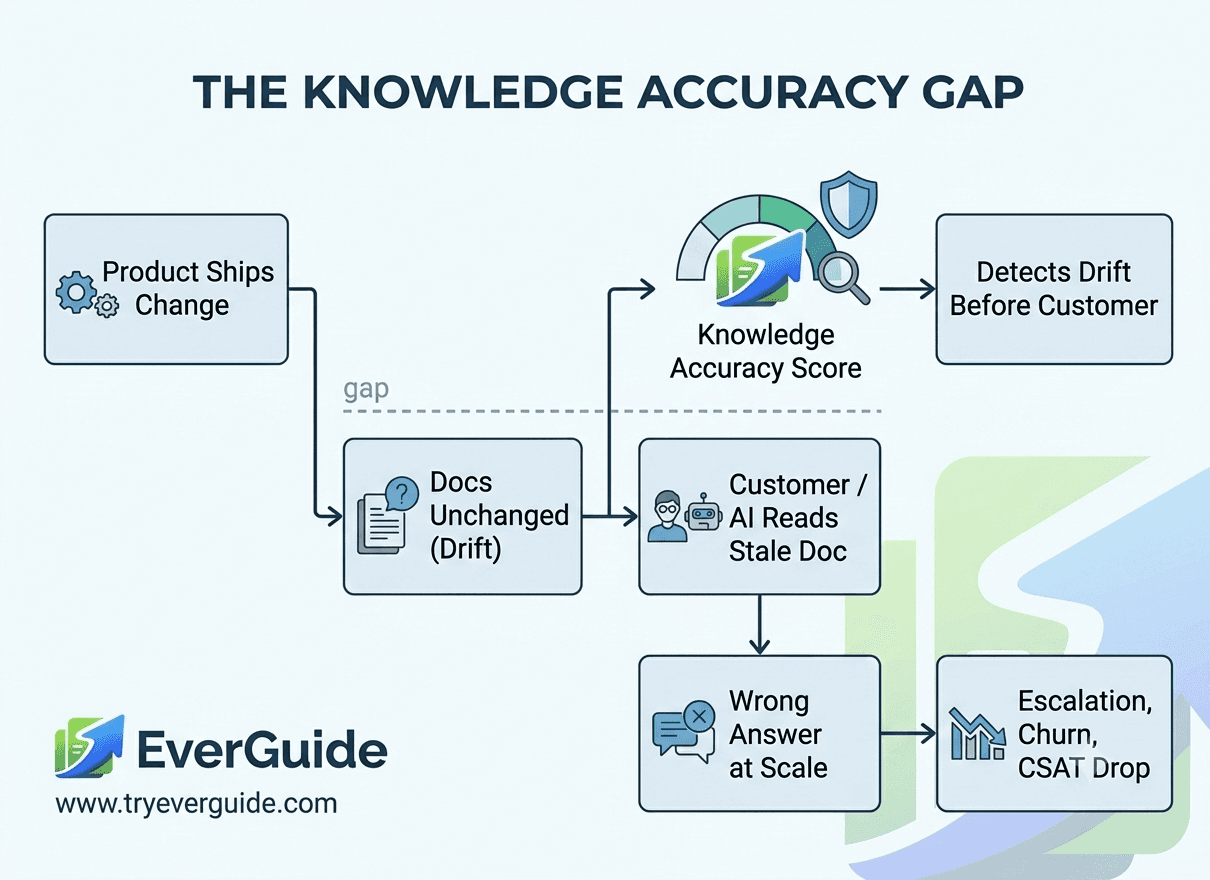
Most metrics measure the damage after it happens. A Knowledge Accuracy Score measures the gap before a customer hits it.
How do you fix customer self-service for good?
You fix self-service by treating your knowledge like monitored infrastructure instead of static content. Measure accuracy continuously, detect drift the moment the product changes, fix what matters most by severity, and keep a human in the loop until your data earns the right to automate. The portal is fine. The knowledge behind it is what needs an owner and a number.
Start by making accuracy a metric your team actually watches, the same way engineering watches uptime. Then close the loop between product changes and documentation so a shipped change triggers a knowledge check, not a customer complaint three weeks later. McKinsey's research is a useful reality check here: most organizations are investing heavily in AI for service but very few have actually scaled it, and the ones who struggle are usually missing the boring foundation of trustworthy knowledge.
A practical sequence most teams can run:
Baseline your accuracy. Get an honest Knowledge Accuracy Score before you buy anything else. You cannot fix what you have never measured.
Detect drift at the source. Tie documentation checks to product releases so you catch breaks when they ship, not when a customer reports them.
Fix by severity. Not every drift matters equally. Rank them so your team spends its limited hours on the breaks that actually mislead customers.
Keep the human in the loop. Approve changes until the data proves the automation is safe. You are buying accuracy, not autonomy.
That last point matters more than it sounds. The temptation with AI is to flip everything to fully automatic, but the whole reason you are doing this is to be more accurate, and unsupervised automation that ships a wrong correction undermines the exact thing you are paying for.
How do you start fixing customer self-service today?
Start by finding out how much of your knowledge is already wrong. Run an accuracy audit against your live product, see exactly which articles have drifted, and fix the highest-severity breaks first. You do not need a new portal to do this. You need to know your real Knowledge Accuracy Score, then close the loop between shipping product and updating knowledge.
Self-service does not fail because customers do not want it. They want it more than they want to talk to you. It fails because the knowledge behind it drifts away from the product, quietly, every release, until the help center and the AI built on top of it are confidently wrong. The teams that win self-service in 2026 will be the ones that stop measuring article counts and start measuring accuracy.
If you want to see your own number, EverGuide runs a free AI Readiness Audit that scans your knowledge base against your live product in minutes and shows you exactly what is broken before your customers find it. That is the fastest way to turn self-service from a cost you tolerate into the channel it was supposed to be.
Frequently Asked Questions
Is customer self-service still worth investing in if resolution rates are low? Yes. The low resolution rate is an accuracy problem, not a demand problem. Customers strongly prefer self-service, and it is by far the cheapest channel, so the return comes from making the knowledge accurate rather than from abandoning the channel. Fixing accuracy is usually cheaper than absorbing the escalations stale content creates.
Will adding an AI chatbot fix my self-service problem? Not on its own. An AI agent grounds its answers in your knowledge base, so if the underlying content is outdated, the bot repeats the wrong answer faster and more confidently. AI raises the value of accurate knowledge and the cost of inaccurate knowledge. Fix the knowledge first, then let the AI amplify it.
What is a Knowledge Accuracy Score? It is the percentage of your help content that still matches what your product actually does today. It is a leading indicator, unlike deflection or CSAT, which only tell you about damage after it happens. Measuring it lets you catch drift before customers and AI agents hit the wrong answer.
How is this different from a digital adoption platform or a doc creation tool? Doc creation tools help you make content faster, and adoption platforms overlay guidance, but neither verifies that your existing knowledge still matches the live product. The accuracy layer is about maintenance and ground truth: continuously checking what you already have against what your product actually does now.
Works Cited
Forrester. (2024). The Total Economic Impact of Freshworks Customer Service Suite
Harvard Business Review. (2017). Kick-Ass Customer Service
Harvard Business School. (2023). Are Self-Service Customers Satisfied or Stuck?
HubSpot. (2025). Customer Service Statistics
McKinsey & Company. (2024). Where Is Customer Care in 2024?